What is Tick2Tick Statistics?
Tick2Tick Statistics is a high‑performance futures trading strategy backtesting and optimization platform built for traders who demand precision, speed, and real‑world accuracy.
Transform intuition into objective data with tick-level precision, because everything you fail to measure will cost you.
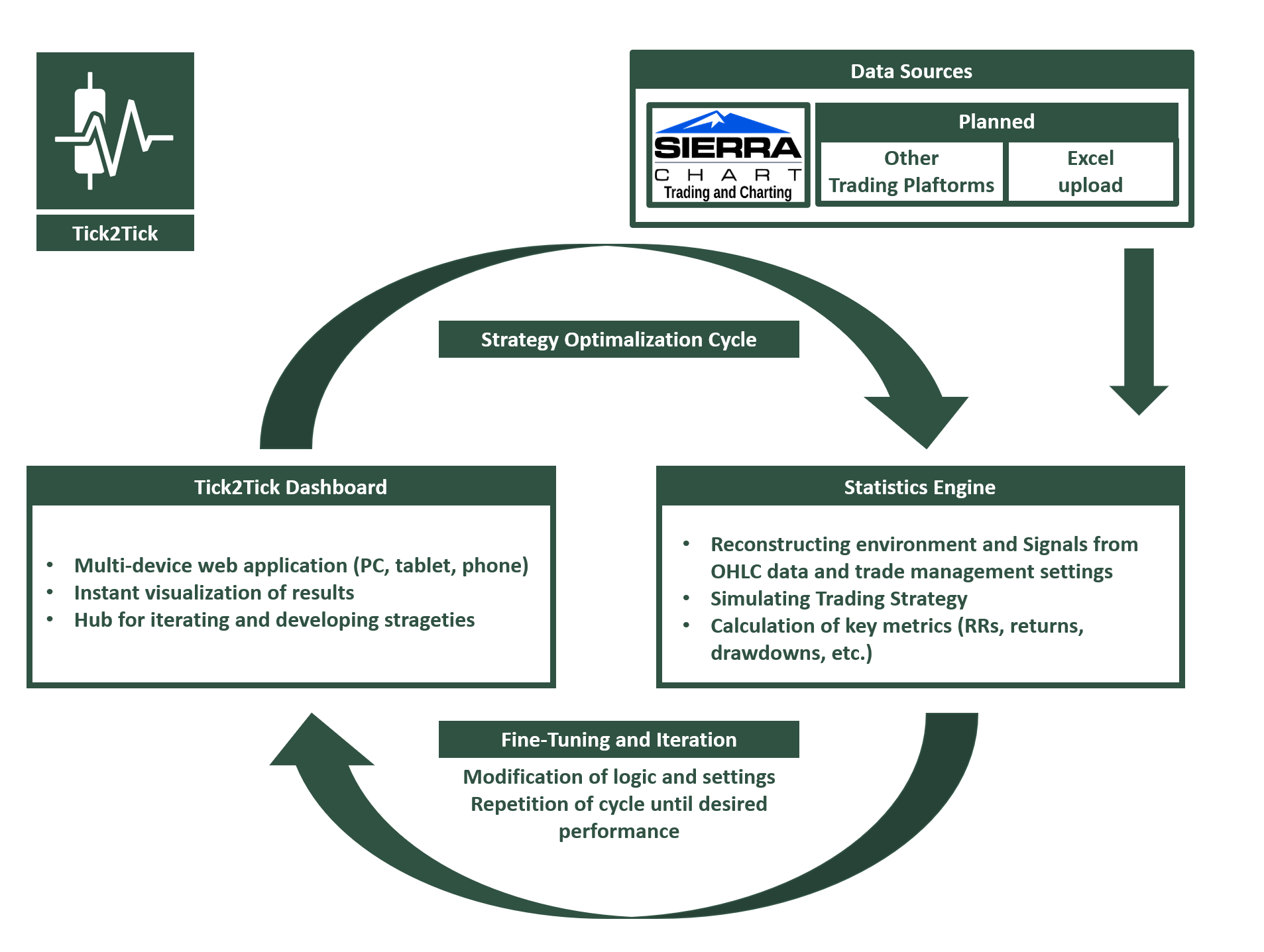
Tick2Tick Statistics – System Overview
Overview
It may feel like magic at first, but the workflow is surprisingly simple:
- Upload your Signals - provide timestamps, price levels, and instructions. It is important to clarify that generating Signals is not the system's task, Tick2Tick only requires the timestamps and OHLC (Open, High, Low, Close) values of your existing Signals. This forms your Statistics Request.
- Define your Trade Management Settings - specify your desired stop-loss levels, profit targets, and your Trailing Stop logic or rules.
- Everything is simulated on tick level data - our engine replays every single price movement (tick) and every trade exactly as it happened in the live market.
- Your strategy is evaluated with industry‑standard metrics - RR (Risk-Reward ratio), returns, drawdowns, and many other performance indicators.
- Results appear instantly in your Tick2Tick Dashboard - analyze, refine, and understand your strategy’s precise behavior.
- Fine‑Tune and iterate - adjust your logic, send a Fine‑Tune Request, and repeat the cycle until your strategy performs exactly the way you want.
- Export your data - integrate the results into your own workflow, tools, or research pipeline.
Tick2Tick Statistics gives you the power to test, improve, and validate your ideas with uncompromising accuracy.
Its place in the trading world
What is the recipe for a successful trading strategy?
1. Signals
This is where every strategy begins. Signals can come from anywhere – automated logic, chart patterns, reversals, support/resistance levels, moving averages, or simply your trained eye. This part is personal and unique to every trader.
It is important to emphasize: Tick2Tick does not develop Signals. The system calculates and visualizes results based exclusively on existing Signal data. It does not examine any aspect of Signal generation, in this regard, it operates on a “zero-level knowledge” principle. To perform measurements and generate statistics, the system requires only the timestamp, the applied timeframe, and the OHLC data associated with the data point.
How to Deliver Data to Tick2Tick
Tick2Tick offers flexible solutions for transmitting your Signals from various sources:
- Signal Uploader (Sierra Chart Custom Study): A ready-to-use, unique module designed to automatically send timestamps, OHLC data, and trade management parameters to our calculation server directly from the Sierra Chart desktop application.
- Excel Upload (planned): You have the option to use your own Excel files. In this case, the file must contain only the data mentioned above (timestamp, OHLC, trade management). The user is responsible for preparing the Excel sheet according to the specified format.
- TradingView Integration (planned): This same path is available if you wish to send signal data from TradingView for calculation and statistical analysis.
- Integration with other major trading platforms (planned): These moduls will work on the same principle as the Sierra Chart integration. These modules are currently in planning phase.
2. Strategy
A signal alone is not enough.
You must measure it. Without testing and proper calculation, even the best‑looking signals can fail in real conditions.
Everything what you can measure, but you fail to do so, will come back at you.
Backtesting and planning your Trade Execution can save enormous amounts of time and money.
This is exactly where Tick2Tick Statistics steps in: it lets you fully plan what, when, and how you want to trade - with real tick‑level accuracy.
3. Trade Execution
Once your strategy is validated and refined, this is where you execute it in the live market.
Bottom line
With Tick2Tick Statistics, you can focus on what truly matters - creating strategies, refining them, and executing them with confidence.
It gives you back time, reduces uncertainty, and when used well, can help you avoid unnecessary losses.